
Pricing your SaaS product before you have a single customer feels like guessing in the dark. You have no data, no feedback, and no proof anyone will pay. But here’s the truth: every successful SaaS started exactly where you are now. They figured out pricing without customers, launched, and adjusted. You can do the same with the right framework.
Pricing your SaaS before launch requires analyzing competitor tiers, calculating your value metric, and setting an anchor price based on customer outcomes rather than costs. Start with 2-3 simple tiers, price 20-30% below established competitors, and plan to adjust within 90 days based on real conversion data and customer feedback.
Why traditional pricing advice fails new founders
Most pricing guides tell you to “know your value” or “understand your customer.” That’s useless when you have zero customers and zero revenue data.
Cost-plus pricing doesn’t work either. Adding a margin to your hosting costs ignores what customers actually care about. A $5 server bill doesn’t justify a $49 monthly price, and it shouldn’t.
The real challenge is that you need a starting point that’s defensible, testable, and won’t scare away your first 100 users.
The value metric framework
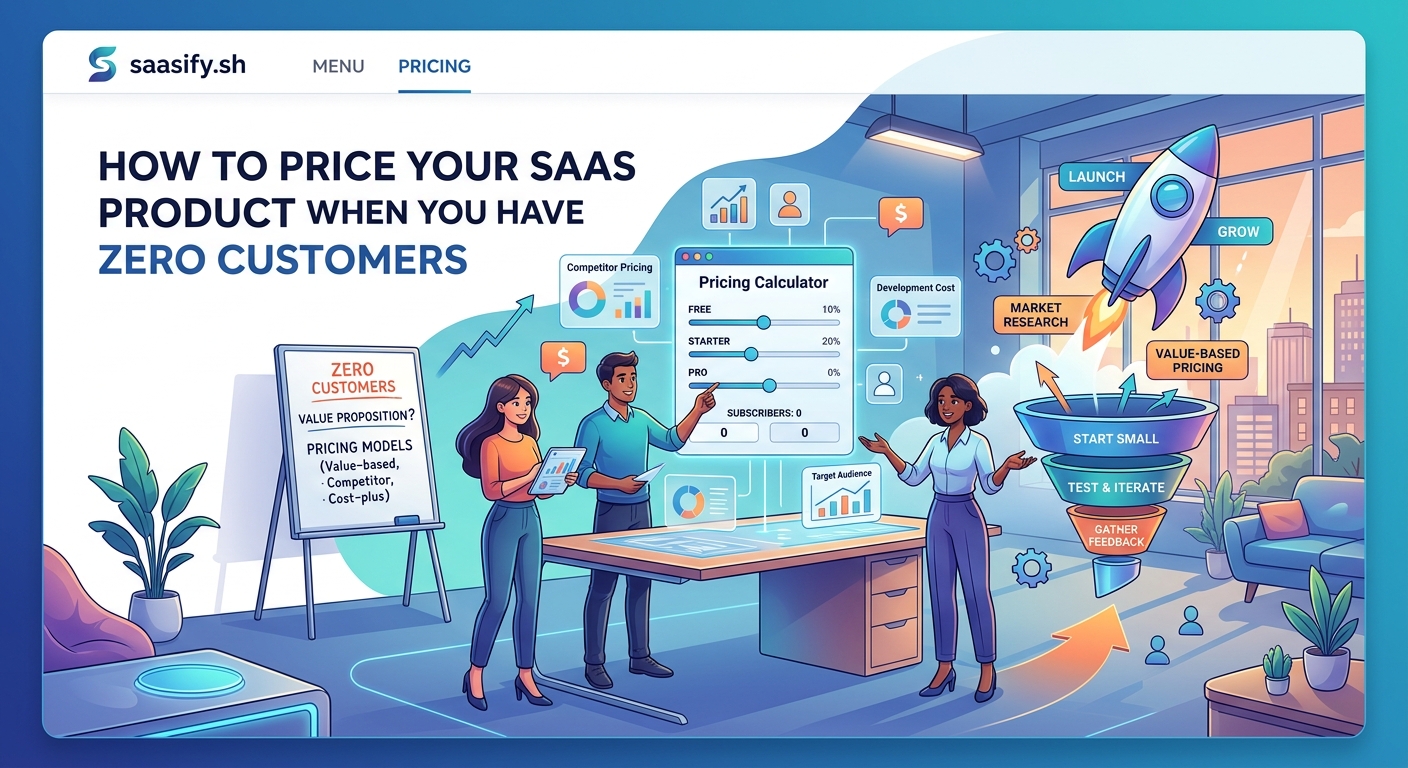
Your value metric is what customers pay for as they use more of your product. Choose this before you set any dollar amounts.
Common SaaS value metrics include:
- Per user or seat
- Per transaction or API call
- Per project or workspace
- Per GB of storage or bandwidth
- Flat rate with feature gates
The best value metric grows naturally as your customer’s business grows. If they succeed, they use more, and you earn more. That alignment matters.
Bad example: charging per login. Customers will share accounts.
Good example: charging per team member. More team members usually means more company growth.
Your value metric should feel fair to customers and scale with the value they receive.
Research competitors without copying them
You need to know what alternatives exist. Spend three hours researching direct and indirect competitors.
Create a spreadsheet with these columns:
| Competitor | Lowest Tier | Mid Tier | Highest Tier | Value Metric | Free Trial |
|---|---|---|---|---|---|
| Tool A | $29/mo | $79/mo | $199/mo | Per user | 14 days |
| Tool B | $49/mo | $99/mo | Custom | Per project | 7 days |
| Tool C | Free | $39/mo | $99/mo | Feature-gated | Forever free |
Look for patterns. Most established SaaS products cluster around similar price points because that’s what the market accepts.
Don’t copy prices exactly. You’re newer, less proven, and probably missing features. Price 20-30% below the established players in your space.
Calculate your anchor price
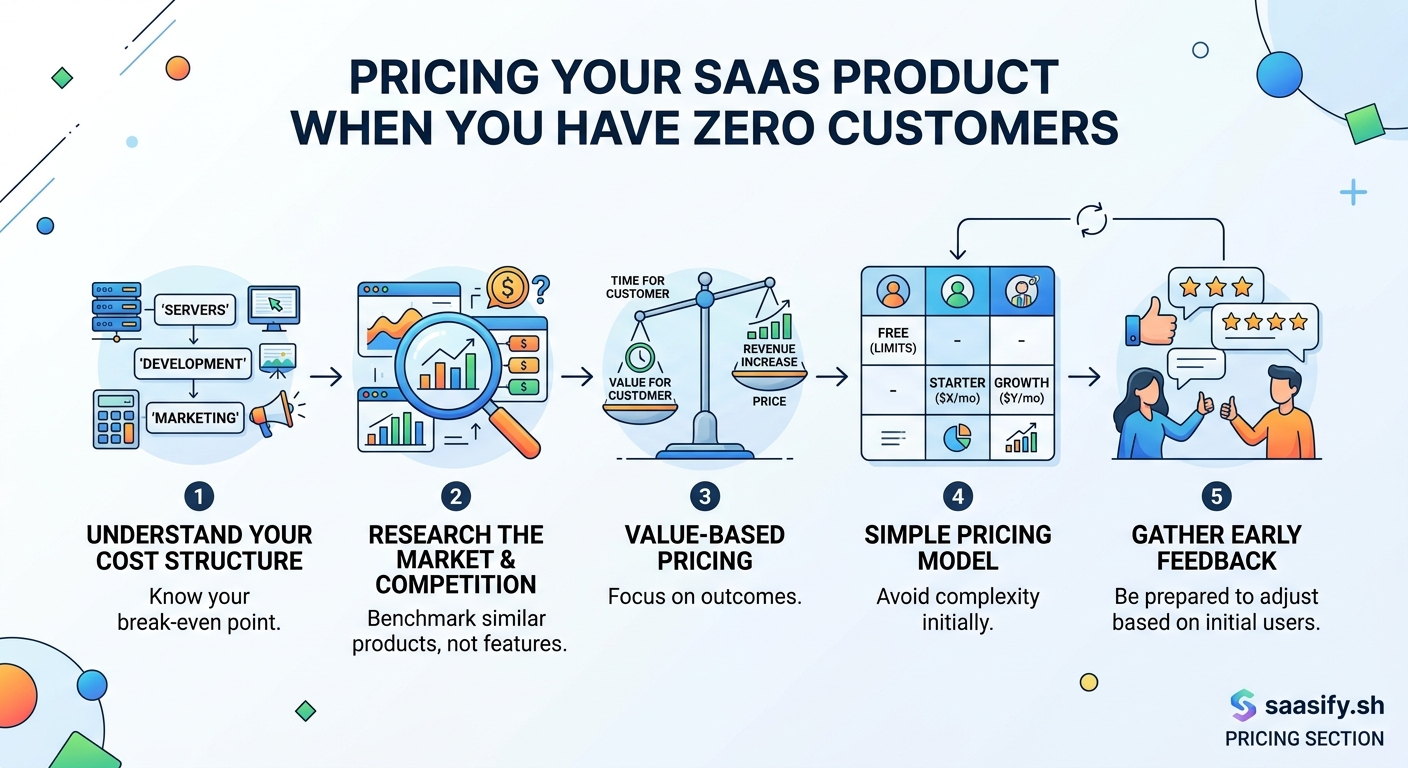
Your anchor price is your middle tier. It’s where you want most customers to land.
Follow this process:
- Identify the main outcome your product delivers (time saved, revenue generated, cost reduced)
- Estimate the monthly value of that outcome in dollars
- Price your product at 10-20% of that value
- Round to a psychologically comfortable number ($49, $79, $99, not $73.50)
Example: Your tool saves a marketing manager 10 hours per month. Their time is worth roughly $50/hour. That’s $500 in value. Price your product at $49-$99 per month.
This isn’t perfect math. It’s a starting framework that connects price to value.
Build your initial tier structure
Most successful SaaS products launch with three tiers. More than that confuses early buyers.
Here’s a proven structure:
Starter tier: 40% of your anchor price. Limited by your value metric. Perfect for individuals or tiny teams testing your product.
Professional tier: Your anchor price. This is your target tier. Include everything most customers need.
Business tier: 2.5-3x your anchor price. Add team features, priority support, and higher limits.
Avoid the temptation to create five tiers. You’ll spend more time explaining options than closing customers.
“We launched with four tiers and nobody knew which to pick. We consolidated to three and conversions jumped 40%. Fewer choices made the decision easier.” – Indie SaaS founder with 2,000+ customers
Price positioning tactics that work
Where you set your price sends a signal about quality and target market.
Pricing under $10/month positions you as a budget tool. You’ll attract price-sensitive customers who churn easily. You’ll need massive volume to survive.
Pricing between $29-99/month hits the sweet spot for most B2B SaaS. It’s low enough for individual buyers to expense without approval, high enough to signal quality.
Pricing above $200/month requires demos, sales calls, and longer sales cycles. Don’t start here unless you’re replacing expensive legacy software.
Annual pricing should offer 15-20% savings. That’s enough incentive to prepay without leaving too much money on the table.
Common pricing mistakes to avoid
New founders make predictable errors. Skip these:
| Mistake | Why It Hurts | Better Approach |
|---|---|---|
| Pricing too low | Attracts wrong customers, signals low quality | Price at market rate minus 20-30% |
| Too many tiers | Creates decision paralysis | Start with 2-3 tiers maximum |
| Hiding prices | Forces unnecessary sales calls | Show pricing publicly unless deal size exceeds $500/mo |
| Complicated metrics | Customers can’t predict their bill | Use simple, predictable value metrics |
| No annual option | Miss out on cash flow and commitment | Always offer annual with 15-20% discount |
The biggest mistake is overthinking. Pick a price, launch, and commit to reviewing after 50 conversations with potential customers.
Test your pricing before launch
You don’t need customers to validate pricing. You need conversations.
Reach out to 20 people in your target market. Show them your product and pricing page mockup. Ask these specific questions:
- Which tier would you choose?
- Does this pricing feel expensive, cheap, or about right?
- What would make you choose the higher tier?
- At what price would this feel too expensive to try?
Listen for hesitation. If multiple people say “I’d need to think about it” at your anchor price, you might be too high.
If everyone immediately says “that’s cheap,” you’re leaving money on the table.
Set up your pricing page
Your pricing page needs to convert visitors into trial signups. Keep it simple.
Each tier should show:
- Tier name (Starter, Professional, Business)
- Price per month and per year
- Your value metric limit (10 users, 100 projects, etc.)
- 4-6 key features, not 20
- One clear call-to-action button
Put your anchor tier in the middle. Make it visually distinct with a border, different background color, or “Most Popular” badge.
Show annual pricing by default. Monthly pricing often gets hidden behind a toggle because annual brings better cash flow and lower churn.
Plan your first price adjustment
You will change your pricing. Every successful SaaS does.
Set a calendar reminder for 90 days after launch. By then you’ll have real data:
- Conversion rate by tier
- Which features customers actually use
- Support load by price point
- Customer feedback on value
Adjust based on patterns, not individual complaints. If 80% of customers pick your lowest tier, your anchor is probably too expensive or your value metric limits are wrong.
If everyone picks your highest tier, you’re underpricing or your tiers aren’t differentiated enough.
Price changes are normal. Grandfather existing customers at their current rate for 6-12 months, then migrate them or let them keep legacy pricing.
Handle the fear of pricing wrong
You’re worried you’ll pick the wrong price and kill your launch. That fear is normal and mostly unfounded.
Pricing mistakes rarely kill products. Bad products kill products. If you’re solving a real problem, you have room to adjust.
Your first price is your best educated guess. It’s not permanent. It’s not carved in stone. It’s a hypothesis you’ll test with real customers.
The cost of overthinking pricing for three months far exceeds the cost of launching at a decent price and adjusting in 90 days.
Your pricing launch checklist
Before you publish your pricing page, verify:
- You have 2-3 clear tiers
- Your value metric makes sense to customers
- Prices are 20-30% below established competitors
- Annual options exist with 15-20% savings
- Feature differences between tiers are obvious
- Your anchor tier is visually highlighted
- Call-to-action buttons are clear
- You’ve talked to at least 10 target customers
Then launch. Watch your analytics. Talk to everyone who signs up and everyone who doesn’t.
Moving forward with confidence
Pricing your SaaS without customers requires research, framework thinking, and courage. You’ve now got a method that hundreds of indie founders have used successfully.
Your first price won’t be perfect. It doesn’t need to be. It needs to be reasonable enough to start conversations and collect data. After 50 customer interactions, you’ll know more about pricing than any consultant could tell you.
Set your price, launch your product, and commit to reviewing after 90 days. The only truly wrong price is the one that never gets tested with real customers.