
Reaching $15,000 in monthly recurring revenue feels like validation. Your SaaS is working. Customers are paying. The numbers climb each month. Then everything falls apart.
Most SaaS failures at $15k MRR stem from preventable mistakes: ignoring churn while chasing growth, building features nobody wants, and running out of cash despite profitability. Founders often mistake revenue growth for business health, missing critical warning signs until recovery becomes impossible. Understanding these patterns helps you spot problems early and make corrections before they become fatal.
Why 15k MRR Becomes a Danger Zone
The journey from $0 to $15,000 monthly recurring revenue teaches you how to acquire customers. You learn marketing channels. You refine your pitch. You close deals.
But the skills that get you to $15k are not the skills that get you past it.
At this revenue level, you face new problems. Your support load increases. Technical debt accumulates. Customers expect more features. Competition notices you. One founder starts feeling stretched thin.
Many bootstrapped founders hit this milestone and assume the hard part is over. They celebrate too early. They relax their focus. They make hiring decisions based on optimism rather than unit economics.
The business looks healthy on the surface. Revenue graphs point upward. Bank accounts grow. Social media celebrates your success.
Then the cracks appear.
The Churn Problem Nobody Sees Coming
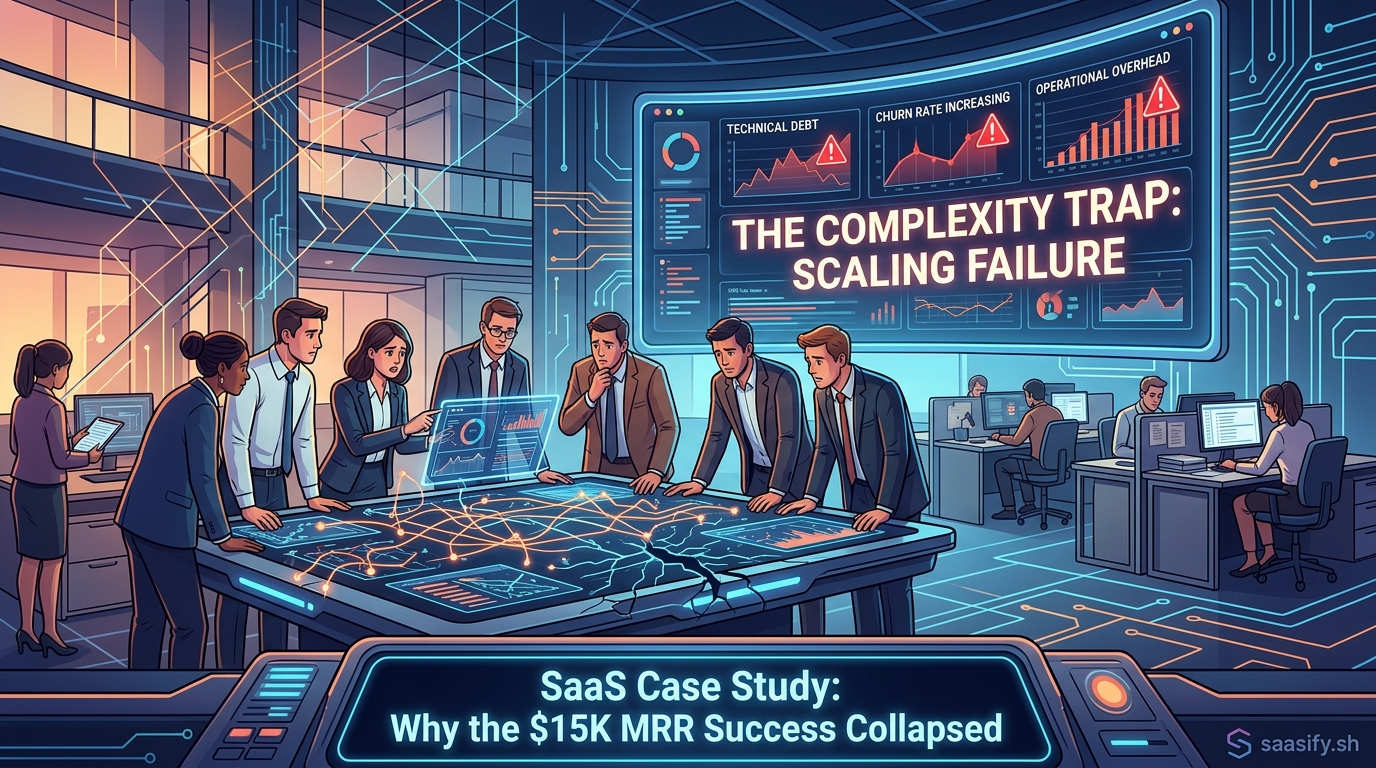
You add 10 new customers this month. You lose 8. Net growth of 2 customers feels like progress until you do the math.
At $15k MRR with an average customer value of $100, you have roughly 150 customers. Losing 8 customers means a 5% monthly churn rate. That compounds to 46% annual churn. You need to replace nearly half your customer base every year just to stand still.
Here’s what founders miss: early customers forgive your product’s rough edges. They signed up because they believed in your vision or knew you personally. They stick around through bugs and missing features.
Later customers have higher expectations. They compare you to established competitors. They churn faster when you disappoint them.
Your churn rate often increases as you grow, even though your product improves. The customers you acquire through paid advertising have less loyalty than the ones who found you organically.
“We were adding $3k in new MRR each month and felt unstoppable. We didn’t notice we were losing $2.5k to churn. By the time we focused on retention, our best customers had already left.” – Former SaaS founder
Three warning signs of dangerous churn:
- Customers cancel within their first 90 days
- Support tickets increase but satisfaction scores drop
- Your best customers downgrade to cheaper plans
The Feature Trap That Kills Momentum
Customers request features. You build them. Nobody uses them. This cycle repeats until your product becomes bloated and confusing.
At $15k MRR, you lack the resources to build everything. But you feel pressure to say yes to feature requests, especially from larger customers or prospects who promise to buy if you add “just this one thing.”
Each new feature creates maintenance burden. It adds complexity to your codebase. It makes your product harder to explain. It slows down your core workflows.
Founders often build features to prevent churn without asking why customers actually leave. They assume the problem is missing functionality when the real issue is poor onboarding, confusing pricing, or a fundamental product-market fit problem.
| Symptom | What It Actually Means | Right Response |
|---|---|---|
| Customers ask for features | They’re trying to solve a problem | Interview them about the underlying need |
| Competitors have more features | They have more resources and complexity | Focus on doing one thing exceptionally well |
| Trial users don’t convert | They don’t see value fast enough | Improve onboarding, not features |
| Power users want customization | Your product serves multiple audiences | Consider focusing on one segment |
The best SaaS products at $15k MRR are often simpler than the ones at $5k. They cut features. They narrow their focus. They say no more than yes.
Cash Flow Mistakes That Seem Invisible
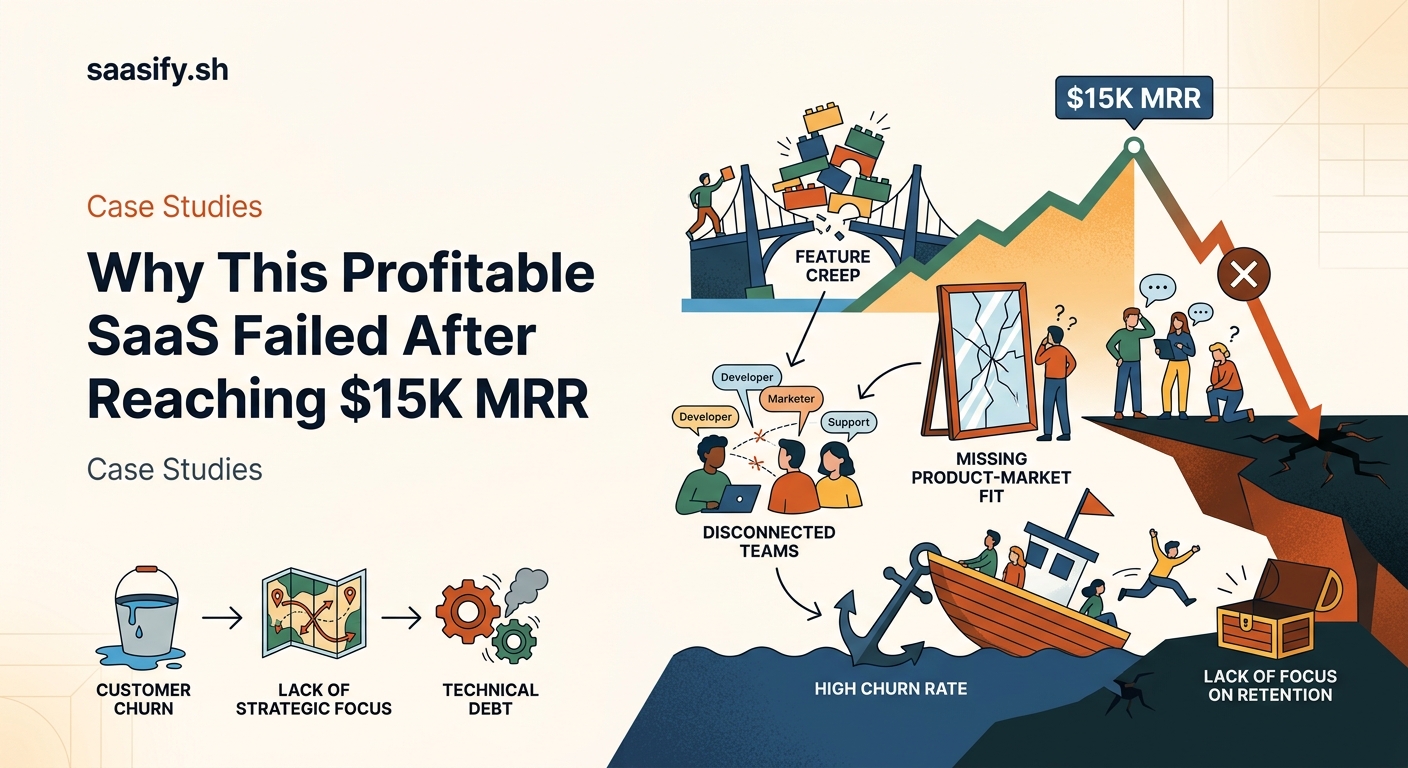
Profitable on paper doesn’t mean cash in the bank. This distinction destroys more SaaS businesses than any other financial mistake.
You land an annual contract worth $12,000. Your accounting software shows $1,000 monthly revenue. But you received all $12,000 upfront. That cash needs to last 12 months of service delivery, not fund a hiring spree.
Annual contracts create a dangerous illusion. They inflate your bank account while creating future obligations. Founders see the cash and spend it on growth, forgetting they need to service those customers for a full year.
Common cash flow traps at $15k MRR:
- Hiring full-time employees based on annual contract revenue
- Paying for annual software subscriptions upfront to get discounts
- Investing in paid advertising without tracking customer payback period
- Building features that require ongoing third-party API costs
- Moving to expensive office space because revenue is growing
Your burn rate matters more than your revenue. A SaaS at $15k MRR with $8k monthly expenses is healthier than one at $25k MRR with $30k monthly expenses.
Calculate your runway constantly. Know exactly how many months you can operate if all new revenue stops tomorrow. If that number drops below six months, you’re in danger.
The Solo Founder Burnout Spiral
You built this product. You know every line of code. You handle every support ticket. You write every marketing email. You close every sale.
At $15k MRR, this workload becomes unsustainable. But you can’t afford a full team yet. You’re stuck in the middle.
Burnout doesn’t happen suddenly. It compounds slowly. You skip workouts. You sleep less. You snap at customers. You stop shipping features. You avoid hard decisions.
The business suffers because you suffer. Response times increase. Product quality drops. Marketing stops. Sales slow down. Churn accelerates.
Then you face an impossible choice: hire someone you can’t quite afford, or keep grinding until something breaks. Many founders choose wrong because they’re too exhausted to think clearly.
Signs you’re approaching burnout:
- You dread opening your support inbox
- You resent customers for having problems
- You haven’t shipped meaningful features in months
- You fantasize about shutting down and getting a job
- You make decisions to reduce your workload rather than grow the business
When Product-Market Fit Wasn’t Real

Getting to $15k MRR proves people will pay for your solution. It doesn’t prove you have product-market fit.
Real product-market fit means customers can’t imagine going back to their old solution. They recommend you without being asked. They upgrade to higher plans. They renew automatically.
Fake product-market fit means customers pay because your solution is slightly better than nothing. They tolerate your product. They churn when something better appears. They never refer anyone.
Many founders confuse early traction with validation. They mistake 150 lukewarm customers for a strong foundation. They scale marketing before nailing retention.
You can build a $15k MRR business on fake product-market fit. You cannot build a $50k MRR business on it. The cracks widen as you grow.
Test your product-market fit honestly:
- Would customers pay 2x your current price?
- Do customers actively refer others without incentives?
- When customers churn, do they come back?
- Can you describe your ideal customer in specific terms?
- Do you win deals based on your product or your price?
If you answered no to most of these questions, you have a revenue problem disguised as a growth problem.
The Competition Catch-Up
At $5k MRR, you’re invisible. At $15k MRR, you show up on competitor radar.
Larger companies notice your customer wins. They see your marketing. They copy your features. They undercut your pricing. They have more resources, more brand recognition, and more patience.
Your advantage was speed and focus. You could ship features in days while they needed months. You could talk directly to customers while they had layers of management.
But as you grow, you slow down. You add process. You hire people. You become more like them, except they have 50x your resources.
Some founders panic and try to compete on features. They build everything their competitor has, plus more. They burn cash trying to keep up. They lose their differentiation.
Others double down on their niche. They serve a specific customer segment better than anyone else. They charge more. They grow slower but build a defensible business.
The second group survives. The first group becomes another SaaS failure case study.
Pricing Mistakes That Cap Your Growth
You set your pricing when you launched. Maybe you charged $49 per month because it felt reasonable. Or $99 because you wanted to seem premium.
That pricing made sense at zero customers. It makes no sense at 150 customers.
Your costs increased. Your product improved. Your target customer evolved. But your pricing stayed the same.
Founders fear raising prices. They worry about customer backlash. They imagine mass cancellations. They grandfather existing customers and only charge new ones more.
This creates a two-tier business. Your best, longest-term customers pay the least. Your newest, least loyal customers pay the most. Your unit economics get worse as you grow.
Underpricing also attracts the wrong customers. People who choose based on price churn faster. They demand more support. They complain about features. They never upgrade.
A SaaS at $15k MRR charging $49 per month has 306 customers. The same SaaS charging $149 per month has 101 customers. Same revenue, one-third the support load, better customer quality.
Price increases done right:
- Announce changes 60 days in advance
- Grandfather existing customers for 6-12 months, not forever
- Add a higher tier before raising base prices
- Explain the value improvements that justify the increase
- Expect 5-10% churn and plan for it
Most founders who raise prices wish they’d done it sooner and more aggressively.
The Partnership Trap
Someone approaches you with an opportunity. They have an audience. They want to promote your product. They’ll send you customers if you give them 30% of revenue forever.
Or a larger company wants to white-label your product. They’ll rebrand it and sell it to their customers. Guaranteed revenue with no marketing effort.
These deals sound perfect when you’re grinding to grow. They promise leverage. They offer validation. They feel like shortcuts.
They’re usually traps.
Revenue sharing deals lock you into bad economics. That 30% comes off the top, before your costs. If your margins are 60%, you just gave away half your profit on those customers.
White-label deals put your product roadmap in someone else’s hands. They want custom features. They need specific integrations. They demand priority support. You build their business instead of yours.
The worst part: these partnerships rarely deliver what they promise. The audience doesn’t convert. The white-label partner sells less than expected. You spent months on integration for minimal return.
Partnerships work when you’re strong enough to walk away. At $15k MRR, you’re usually not.
When Growth Hides the Problems
Revenue growth feels like success. The number goes up each month. You celebrate milestones. You share wins on social media.
Growth masks problems until they become catastrophic.
Your churn rate increases but gross revenue still grows. Your customer acquisition cost doubles but you’re still profitable. Your founder burnout worsens but you keep shipping.
Then one month, growth stops. Maybe a marketing channel dies. Maybe a competitor launches. Maybe you just run out of easy customers.
Without growth to hide behind, all your problems appear at once. High churn means revenue drops fast. Expensive acquisition means you can’t afford to replace churned customers. Burnout means you can’t execute your way out.
The business that looked healthy at $15k MRR collapses to $8k MRR in three months. Recovery becomes nearly impossible because you’re fighting multiple fires with depleted resources.
Smart founders fix problems while growing. They improve retention before scaling acquisition. They hire before burning out. They raise prices before margins compress.
Growth should be the result of a healthy business, not a substitute for one.
Lessons From Founders Who Survived
Not every SaaS at $15k MRR fails. Some push through to $50k, $100k, and beyond. They make different choices.
They obsess over retention metrics. They track cohort analysis. They interview churned customers. They fix onboarding before building new features.
They say no constantly. They turn down feature requests. They reject partnership offers. They ignore competitor moves. They protect their focus ruthlessly.
They charge more than feels comfortable. They raise prices regularly. They fire bad-fit customers. They target customers who value their solution, not customers who want cheap software.
They build systems before hiring people. They document processes. They create templates. They automate repetitive work. They make themselves replaceable.
They manage cash conservatively. They maintain 12-month runways. They avoid annual expenses. They track unit economics obsessively. They grow within their means.
Most importantly, they treat $15k MRR as the beginning of the hard part, not the end. They know the business needs to evolve. They’re willing to change what worked before if it’s not working now.
What This Means For Your SaaS
Reaching $15k MRR proves you can acquire customers. Surviving past it proves you can build a business.
The difference comes down to honest assessment. Look at your churn rate without excuses. Calculate your real customer acquisition cost. Measure your founder capacity truthfully. Evaluate your product-market fit critically.
Fix the problems growth is hiding. Improve retention before scaling acquisition. Raise prices before hiring. Build systems before burning out.
Your SaaS won’t fail because you lacked ambition or worked too little. It will fail because you missed the warning signs that were visible all along.
Pay attention to them now, while you still have time to correct course.